
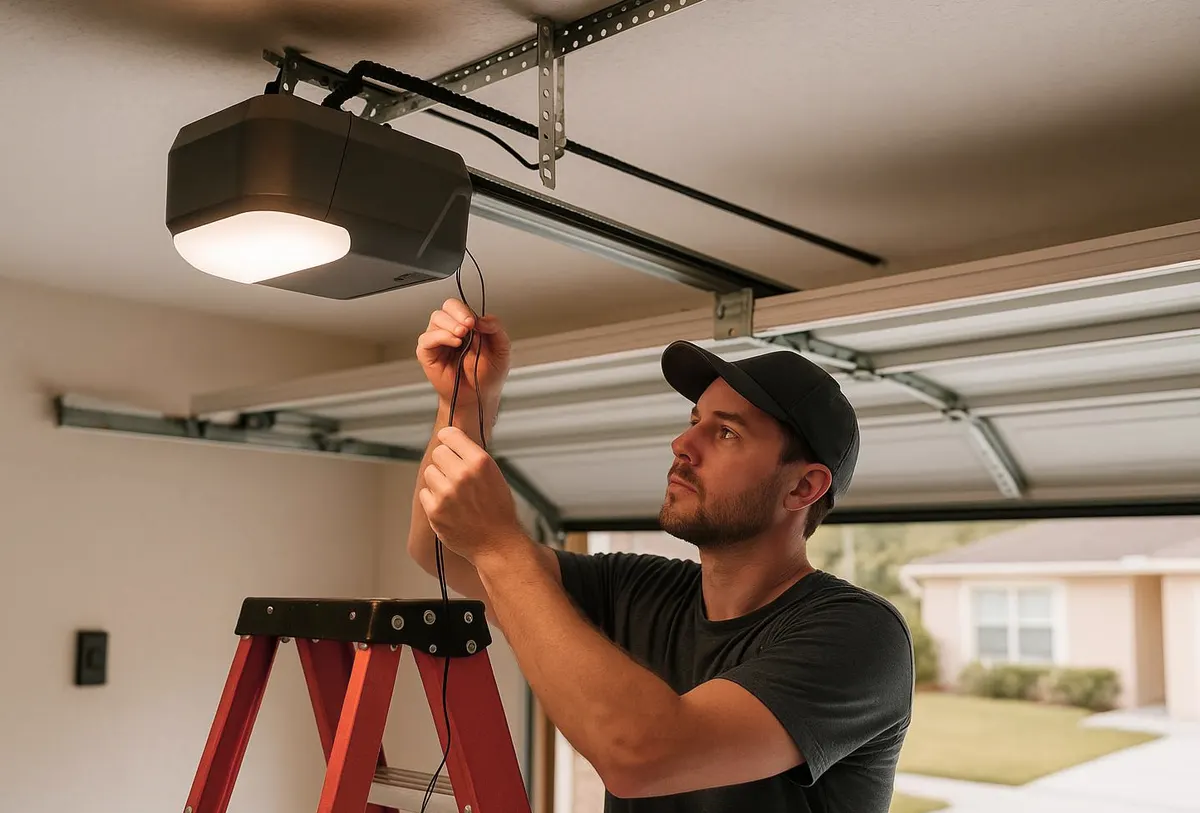
You hear it before you see it—a loud bang from the garage, like a car backfired inside your house. You walk in, hit the opener button, and the door either doesn't move at all or only lurches up a few inches before stopping. Above the door, one of the two springs is hanging loose, split clean in half, maybe with a visible gap where it used to be wound tight. Your first thought is probably how hard can this be to replace? The honest answer: harder, and more dangerous, than almost anything else you'll ever touch in your house.
What That Spring Was Actually Doing
A garage door can weigh anywhere from 130 to over 400 pounds depending on the material and size. The springs—usually a torsion spring mounted on a bar above the door, or a pair of extension springs along the upper tracks—are what counterbalance that weight so the opener motor (or you, lifting by hand) only has to manage a few pounds of force instead of the door's full weight. To do that job, a torsion spring is wound under extreme tension, sometimes dozens of full turns, storing an amount of energy roughly comparable to a stick of dynamite in terms of sudden release force. When it fails, or when someone tries to unwind or remove it without the right tools, that energy doesn't leak out gently. It releases all at once.
How Badly This Can Go
This is not theoretical caution. Emergency rooms see garage door spring injuries every year, and they tend to be serious: broken fingers and hands from springs recoiling during removal, facial lacerations and eye injuries from flying winding bars or metal fragments, and crush injuries from a door that drops unexpectedly once the spring tension is gone. A torsion spring under load can snap a standard screwdriver like a twig if you try to use one as a winding bar instead of the correct solid steel bars sized for the job. People have lost fingers this way. It's one of the few home repairs where the injury pattern looks more like a workshop accident than a home improvement mishap.
Why This Isn't Like Other DIY Jobs
Most repairs around the house fail safely—a mistake means you redo it. A garage door spring fails violently, because the whole point of the part is to hold a massive amount of stored energy in a small space. A few things make this worse for homeowners who've never done it before:
- Torsion springs require winding bars, not drills or screwdrivers. Using the wrong tool is the single most common cause of serious injury.
- The door itself can fall if it's not properly secured with clamps while the spring is disconnected, putting hands, feet, or anyone nearby at risk.
- Spring sizing matters. The wrong wire gauge, coil diameter, or wind direction can cause premature failure or an opener that strains and burns out trying to compensate.
- You're often working overhead, on a ladder, near a heavy moving assembly, which adds a fall risk on top of everything else.
What Actually Prevents the ER Visit
If you notice a spring has snapped, or you can see visible gaps, rust, or stretching in the coils, the safest and most useful thing you can do yourself is stop using the door and leave the spring alone:
- Disconnect the opener by pulling the manual release cord so the motor doesn't keep trying to force a door it can't lift safely.
- Don't manually lift the door if you suspect spring failure—without the spring's counterbalance, the weight is entirely on you and whatever is holding the door in place.
- Keep kids and pets out of the garage until the spring is replaced; a loose or partially wound spring is not something to work around.
- Don't attempt to unwind, cut, or remove the spring yourself, even if it looks straightforward. This is the step where most injuries happen.
- Have both springs inspected together. If one failed from age or wear, the other is usually close behind, and replacing both at once saves a second service call.
Why Springs Fail Here Specifically
Garage door springs are rated for a certain number of open-close cycles, typically somewhere in the 10,000–20,000 range, and several local conditions can burn through that lifespan faster than the manufacturer's estimate. Long, hot summers cause metal to expand and contract repeatedly, which fatigues the coil over time. Dust and blowing grit work their way into the coils and accelerate wear on top of normal friction. And sudden storms with high wind can cause a door to rattle, catch, or get slammed by gusts if it's left partway open, putting extra stress on springs that are already working at their rated limit. None of that means springs fail overnight for no reason—but it does mean a spring that's lasted ten or more years in this climate is living on borrowed time, and a sudden snap shouldn't come as a total shock.
When to Call Magnolia Door & Opener
If a spring has already broken, or you're hearing new creaking, seeing visible wear, or noticing the door feels heavier than it used to, that's the signal to call rather than troubleshoot further. Magnolia Door & Opener handles spring replacement with the correct winding bars, properly rated torsion or extension springs, and the safety clamps needed to keep the door secure during the job. We'll also check your cables and rollers while we're in there, since a failing spring often puts extra strain on those parts too, and a quick maintenance visit can catch a weakening spring before it snaps and leaves you stuck.
If your garage door in Magnolia, Tomball, The Woodlands, or anywhere nearby is showing signs of spring trouble, don't wait for the loud bang. Call Magnolia Door & Opener and let us handle the part of your garage that's genuinely dangerous to touch yourself.